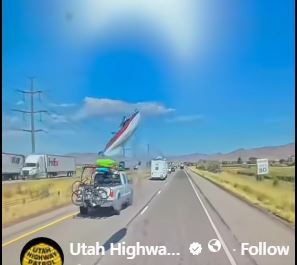
When we think about boat safety, we should also think about what needs to happen to get the boat TO THE LAUNCH, or then, back home, after the paddle trip.
That means: TIE YOUR BOAT TO YOUR VEHICLE so it doesn't come off.
Tie from the front of your boat to the front of your car. Tie from the back of your boat to the back of your car. Tie from one side of your boat so it doesn't slide off to that side of your car, and from the other side of your boat so it doesn't slide off the other side of the car.
Also, tie it DOWN, so it doesn't become airborne along the way. I have kayaks that are natural airfoils, and if I arrange them with the bow of the boat facing forward, they tend to lift off the boat racks. So I must carry them with the bow facing towards the back of the car. I also wrap the side straps around the crossbars of the boat racks, to hold the boat tight to the crossbars.
Protect your boat from the five directions of vehicle movement – back and forward, and side to side, and up. Consider wind load, vibration and sudden stops. So, you need to have a strap to the front of the vehicle, a strap to the back of the vehicle, and straps preventing side to side motion. I tend to use straps with buckles to strap the boat down to the top racks, and ropes to tie the bow and stern of the boat to the front and back of the car with trucker's hitches.
I've seen pictures where both the boats and the racks have ripped off the car. Keep the straps and ropes tight.
Let's talk about "Bunny Ears." These are auxiliary straps you add to the engine compartment of your car, that extend out of the front of the hood, and serve as connection points for the ropes that attach to the front of the boat. They are typically made from inch and a half wide strapping, and are bolted to the frame at the front of the engine compartment.
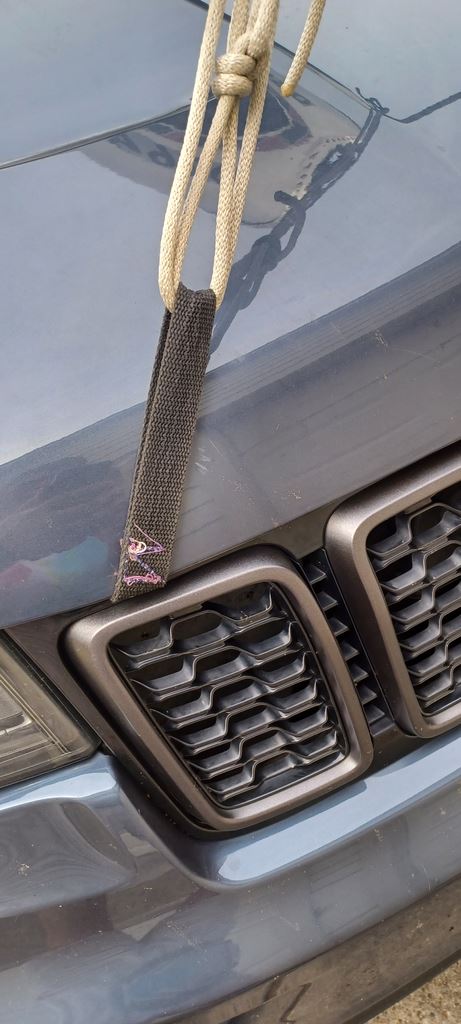
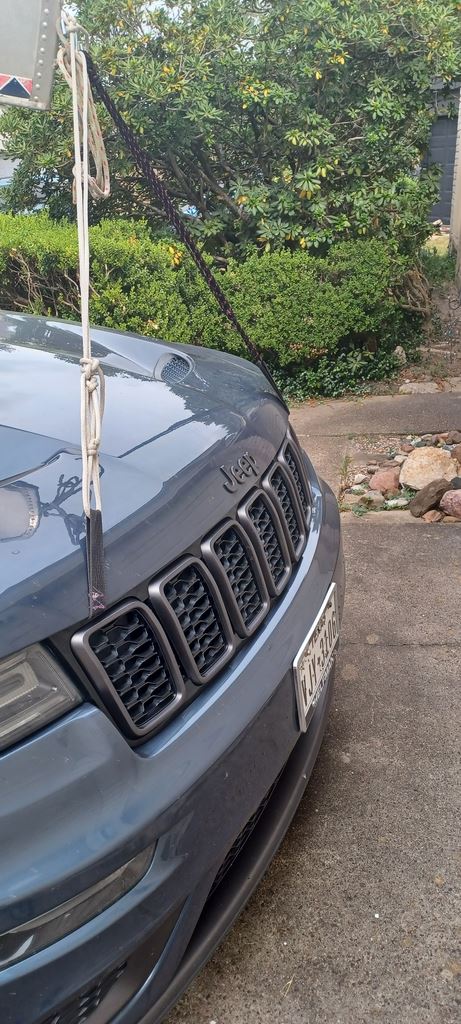
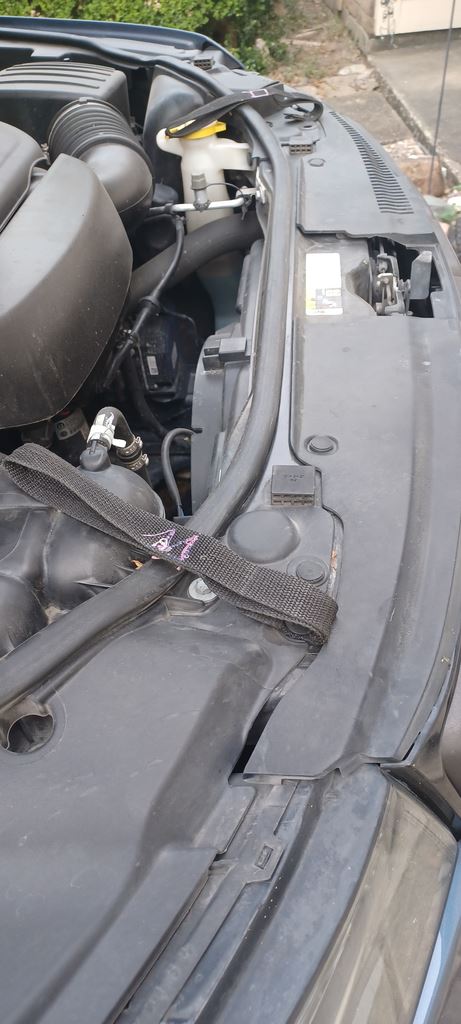
When not in use, they fold back into the engine compartment, out of the way.
The vehicles I am familiar with have all had rear trailer hitches, so it was easy to tie the back of the boat to the hitch on the car. I've been watching youtube videos and some of the people have used a thing they called a "Quickie Hood Loop" which looked like a webbing loop that included a length of plastic pipe that stayed inside the hood, or inside the back hatch, and the loop stayed outside after the hatch was closed, as a connection point. Interesting.
Editor's note: Some people have informed me that many vehicles these days come equipped with a "Towing Eye" bolt that can be screwed in to a recessed bolt hole in the front of the vehicle. This provides a solid substantial connecting point to attach front connections to your boat. I haven't had any experience with these, but if your vehicle offers such a provision, that might make a better alternative than bunny ears.
Then, also, my last truck had substantial tow hooks as part of the front bumper, which could be used to tow semi-trucks out of ditches, so I used those at the time.
Re-check the tension after a short test drive.
Don’t let shortcuts compromise safety. After the first 10 miles, stop and test the tension and inspect the straps. Replace frayed straps and bent chains immediately. Try to arrive at the launch site with your boat intact.
Stay safe out there!
See you On The Water!

Author, Harmon Everett